Rough-Terrain Crane
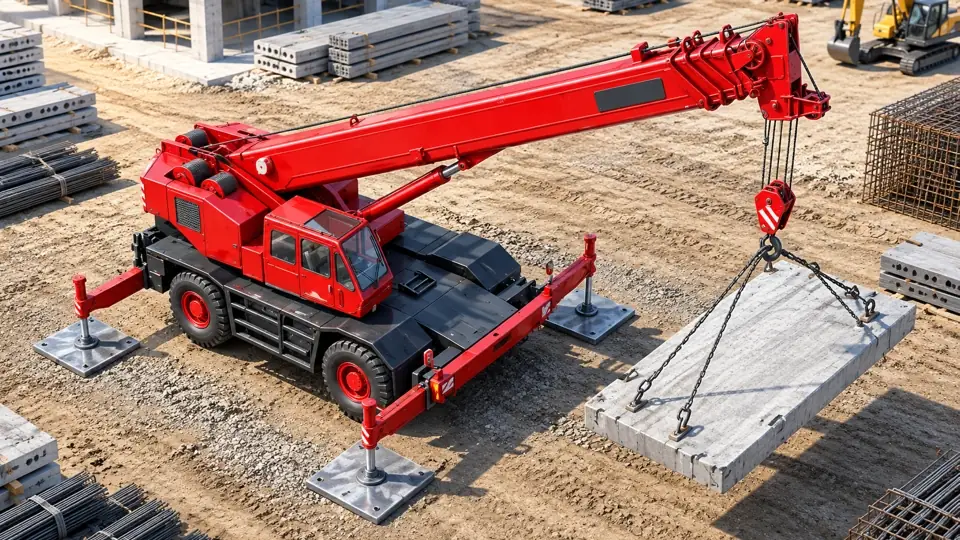
This is a self-propelled, rough-terrain, pneumatic-tired crane designed for the assembly of structural components, the installation of industrial equipment, and the handling of heavy loads on construction sites. It has a lifting capacity of 25 tonnes and a maximum four-section telescopic boom length of 31 meters; with an additional jib extending up to 13 meters, the lifting height reaches approximately 45 meters. The boom is extended via hydraulic cylinders and a telescoping mechanism, while its angle is adjusted by a separate hydraulic cylinder. Load lifting and lowering are performed using a winch, cable, and hook assembly; adjusting the boom's operating radius allows the load to be moved across the work area, with the permissible load depending on boom length, radius, crane position, and outrigger configuration. Four hydraulic outriggers with support pads ensure stability during heavy lifts. The superstructure—comprising the operator's cab and the boom—rotates relative to the wheeled chassis, enabling site coverage without repositioning the machine. The chassis features two axles and four wheels, with selectable two-wheel or four-wheel drive and steering modes to enhance maneuverability. Propulsion is provided by a 7.5-liter, 165 kW turbocharged diesel engine coupled with a multi-speed transmission, allowing for a maximum travel speed of 50 km/h. The crane measures 11 m in length, 2.6 m in width, and 3.5 m in height, with an operating weight of 26.5 t. A hydraulic system controls the boom, winch, superstructure rotation, and outriggers, while load monitoring instruments and safety devices help prevent operation outside permissible limits. Its compact chassis and ability to travel under its own power between job sites make this rough-terrain crane well-suited for construction, installation, and industrial applications.
Model Information
Anton Dubina
In Progress
Car
In Development
TBA