Rocket engine Flow
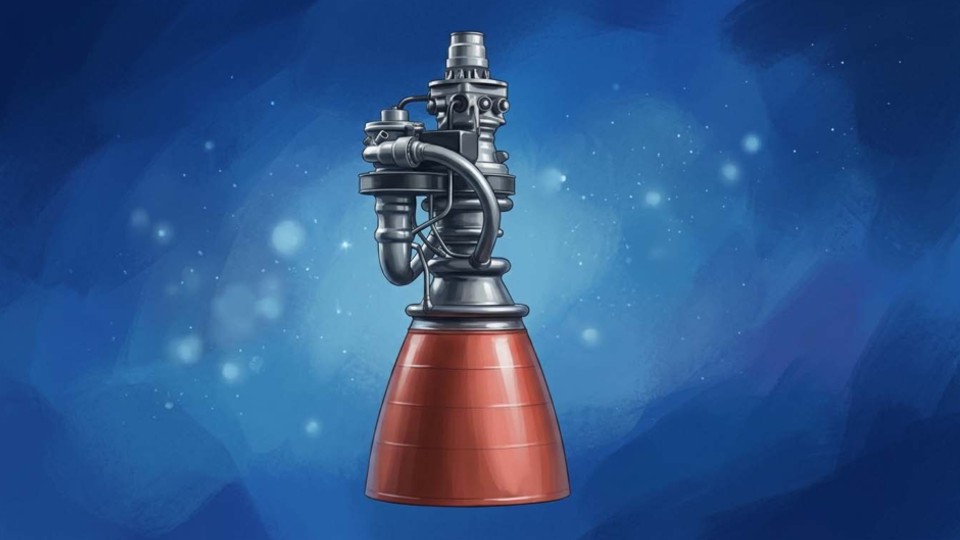
A single-chamber liquid-propellant rocket engine. The engine utilizes cryogenic liquid methane (CH₄) and liquid oxygen (LOX) and operates on a closed-cycle scheme with full gasification of the propellants. The single-chamber engine design incorporates fuel and oxidizer turbopumps, pre-burners, a main combustion chamber, an injector, an ignition system, and a regeneratively cooled chamber and nozzle. Methane and oxygen flow from the tanks to the turbopumps, which boost their pressure before delivery to the engine. A portion of the propellants passes through separate pre-burners, generating hot gas flows that drive the pump turbines; the resulting gaseous propellants then enter the main combustion chamber, where the methane burns in the oxygen to produce high-temperature gases. As they expand through the nozzle, the gases convert thermal energy into a high-speed exhaust jet, generating thrust. The engine operates at high pressures and temperatures. It is capable of throttling thrust over a wide range, and its mounting assembly allows for thrust vectoring—deflecting the thrust direction relative to the engine's longitudinal axis—to control the rocket. The engine delivers 3 MN of thrust at sea level, operates at a combustion chamber pressure of 300 bar, offers a throttling range of approximately 20% to 100% of maximum thrust, and achieves a specific impulse of about 334 seconds at sea level. The engine integrates a high-energy methane cycle, a turbopump system, regenerative cooling, a compact design, and thrust vector control into a single-chamber propulsion unit.
Model Information
Anton Dubina
In Progress
Car
In Development
TBA