Bomber Raven
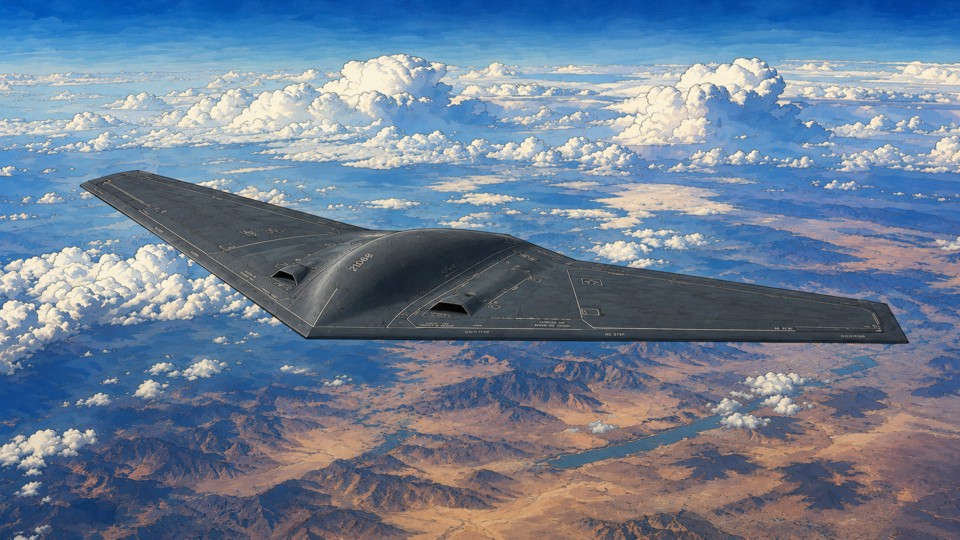
This long-range strategic unmanned bomber features a "flying wing" configuration designed for extended missions with the payload housed in internal bays. The airframe utilizes an integrated design characterized by a smooth transition between the wing and the central fuselage, a swept leading edge, and a minimal number of protruding elements. Internal volume is efficiently allocated for fuel tanks, computing hardware, and control, communication, and navigation systems. The nose section—freed up by the absence of a crew cockpit—is dedicated entirely to advanced onboard avionics, additional mission-specific systems, and a precisely balanced fuel compartment. The propulsion system consists of two geared turbofan engines mounted on the upper rear section of the airframe; their air intakes are integrated into the fuselage and shielded to prevent direct radar visibility of the compressor faces. The tricycle landing gear retracts fully into the fuselage, with the main gear units housed in isolated bays. Aircraft control is managed by a digital fly-by-wire system. An onboard computer continuously processes data from inertial and satellite navigation systems and air-data sensors, generating commands for the actuators. In the absence of a vertical stabilizer, directional control is achieved through the use of split control surfaces at the wingtips and by differentially modulating the thrust of the left and right engines. Mission execution, navigation, and piloting are handled entirely automatically by the onboard computing system. During takeoff and landing, the automated system maintains precise speed, altitude, and glide-path parameters by synchronously controlling aerodynamic surfaces and the engine autothrottle. The internal bays are equipped with mechanisms for securing and precisely releasing the payload; when closed, their doors form a perfectly smooth airframe surface that does not compromise aerodynamics. The bomber’s design is entirely focused on low radar observability: the airframe geometry, surface junctions, recessed air intakes, and shielded nozzles are engineered to optimize the reflection and scattering of radar waves, while the exterior is protected by a special radar-absorbent coating. The unmanned architecture fully integrates the propulsion system, digital controls, navigation, secure communications, and sensors into a unified, intelligent onboard suite capable of executing ultra-long-range autonomous missions.
Model Information
Anton Dubina
In Progress
Car
In Development
TBA