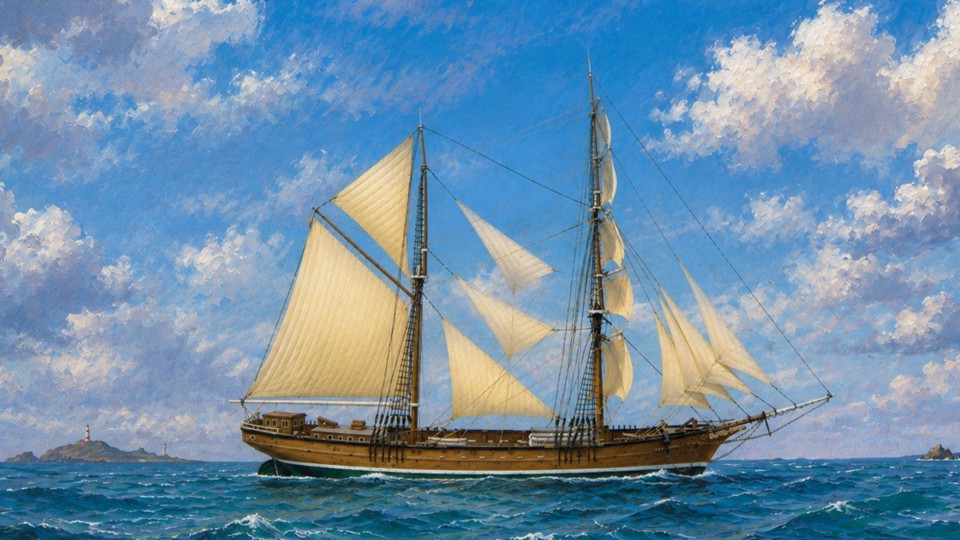
Brigantine Katya
This is a two-masted sailing research vessel from the 16th-century Age of Discovery, designed for coastal navigation, the search for new islands, and the exploration of trade routes. Its structure is based on a wooden hull featuring a keel, ribs, and decking, housing cargo holds, provisions, fresh water supplies, tools, and crew quarters. Superstructures are located at the bow and stern, while deck areas along the sides facilitate the handling of sails, rigging, and small boats. The brigantine features two masts with square-rigged sails; each mast carries yards supporting square sails that capture wind pressure and convert it into thrust. Sail tension and positioning are controlled by a system of tackle, blocks, and lines, allowing the angle of the sails to be adjusted relative to the wind direction. With a following or beam wind, the vessel moves primarily under sail, steered by a stern-mounted rudder connected to a steering mechanism on deck. A dedicated rowing system is provided for movement during calm weather or when maneuvering in confined spaces; rowers apply force through oars directly against the water, generating forward thrust regardless of wind conditions. This combination of sail and oar propulsion enables the brigantine to maintain headway in the absence of wind and approach the shore without the aid of tugboats. The hull has a relatively shallow draft, allowing for the exploration of shallows and entry into bays inaccessible to large ocean-going vessels. The brigantine integrates sail propulsion, manual rowing power, a steering system, cargo holds, and an extensive rigging setup into a compact maritime platform designed for long, autonomous expeditionary voyages.
Model Information
Anton Dubina
In Progress
Car
In Development
TBA