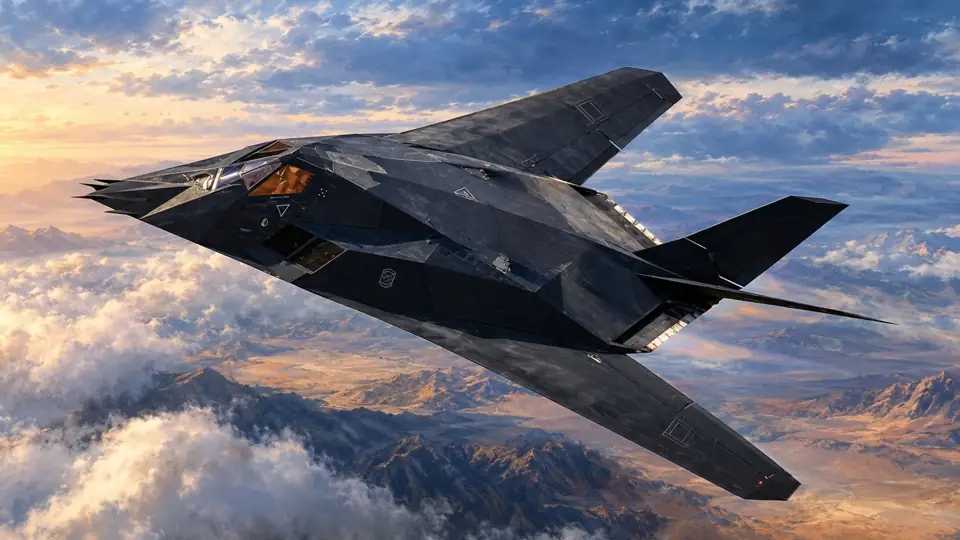
Stealth (1980)
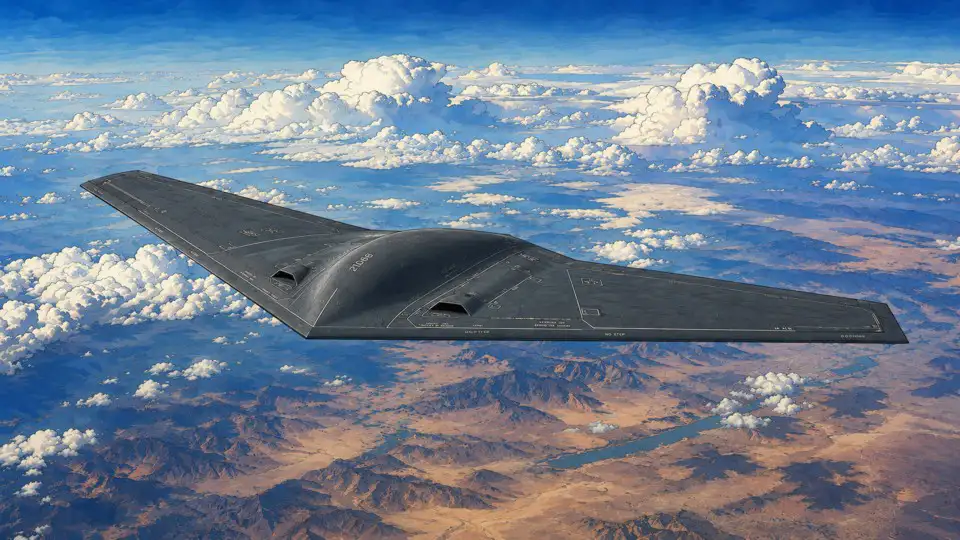
This is a subsonic strike aircraft. It features a single-seat cockpit and a high-mounted swept-wing configuration, with a distinctive faceted fuselage composed of flat panels joined at specific angles. The aircraft measures 20 meters in length, has a wingspan of 13 meters and a height of 3.8 meters, and a maximum takeoff weight of 24 tonnes. The propulsion system, located in the central fuselage, consists of two non-afterburning turbofan engines. Air intakes are positioned on the sides of the fuselage and covered by grilles that prevent a direct line of sight to the compressor faces. The exhaust nozzles are located at the rear and feature a flat, slot-like shape. The landing gear is a tricycle arrangement, with one nose gear and two main gear units that retract into the fuselage and wings. The airframe relies on aluminum and titanium structural elements; the skin consists of complex-geometry panels, and the exterior surfaces are coated with radar-absorbent materials. Armament is housed in internal bays within the central fuselage, allowing the aircraft to maintain a smooth external profile. The cockpit is equipped with an ejection seat, an instrument panel, flight controls, and information display systems. Navigation and weapon employment rely on an inertial navigation system, a digital onboard computer, a laser rangefinder-designator, and an infrared surveillance system. The aircraft achieves a maximum speed of approximately 990 km/h and has a service ceiling of 14 km. The aircraft's unusual shape resulted from the use of computational methods to reduce its radar cross-section: flat panels and inclined surfaces deflected reflected radar energy away from the source. It was one of the first production combat aircraft designed with low observability as a priority.
Model Information
Anton Dubina
In Progress
Airplane
In Development
TBA