Voyager 1 Space Probe (1977)
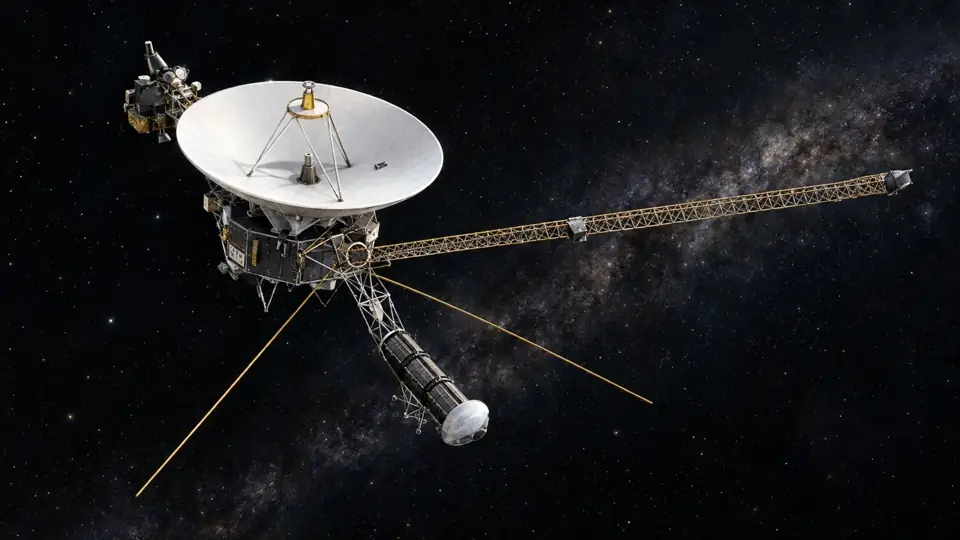
An automated NASA space probe designed to explore the outer planets of the Solar System and interstellar space. With a launch mass of approximately 722 kg, the spacecraft features a modular design comprising a pressurized electronics housing, a 3.7-meter high-gain parabolic antenna, a rotatable science instrument platform, booms for magnetometers and antennas, and three radioisotope thermoelectric generators (RTGs). Electrical power is generated from the heat produced by the decay of plutonium-238 and supplies the onboard computers, communication systems, and scientific instruments; as power output naturally declines, NASA engineers sequentially switch off non-essential systems. The original scientific payload included cameras, ultraviolet and infrared spectrometers, a magnetometer, plasma and radiation detectors, and instruments for detecting cosmic rays and radio waves. Voyager 1 launched on September 5, 1977, aboard a Titan IIIE-Centaur rocket; it flew past Jupiter in 1979 and Saturn in 1980 before continuing toward the outer boundary of the heliosphere. On August 25, 2012, the spacecraft crossed the heliopause, becoming the first human-made object to enter interstellar space. A three-axis stabilization system continuously points the main antenna toward Earth, and data transmission is handled via NASA's Deep Space Network. Its maximum speed relative to the Sun is approximately 17 km/s, or 3.6 AU per year. As of 2026, Voyager 1 continues to operate at the limits of its available power; following the deactivation of the LECP instrument in April 2026, the magnetometer and plasma wave subsystem remain operational, transmitting scientific data from a region inaccessible to other spacecraft. Also on board is the Voyager Golden Record—a 30-centimeter gold-plated disc containing images, sounds, and greetings from Earth.
Model Information
Anton Dubina
In Progress
Ship
In Development
TBA