Rocket Impulse
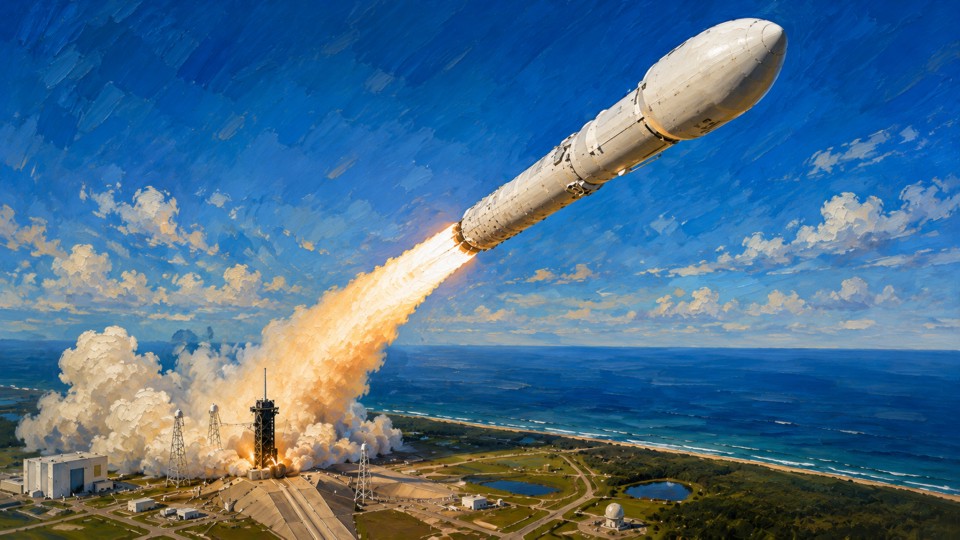
A reusable launch vehicle capable of vertical takeoff and landing. The rocket consists of a cylindrical fuselage containing two main cryogenic tanks—for liquid methane and liquid oxygen—an inter-tank section, an engine section, and an upper adapter for mounting the payload. Impulse utilizes a flight control system, navigation equipment, a structural airframe, and engines capable of thrust and thrust-vector modulation. The propulsion system comprises multiple closed-cycle liquid-propellant rocket engines featuring full propellant gasification. Liquid oxygen and methane are supplied by high-pressure turbopumps; a portion of the propellants passes through separate pre-burners to drive the pump turbines, after which the resulting gases enter the main combustion chamber. This configuration allows virtually the entire propellant flow to be used for generating thrust and is designed for high combustion chamber pressure. The engines feature thrust vectoring: swiveling the nozzle assemblies relative to the rocket's longitudinal axis alters the thrust direction, a capability used by the control system for stabilization, maneuvering, and trajectory control. Upon completion of the boost phase, the first stage separates from the upper section of the rocket and begins a controlled return. The engines are reignited for deceleration, while aerodynamic control surfaces adjust the vehicle's attitude during passage through the dense layers of the atmosphere. Prior to landing, the rocket reduces its vertical velocity using engine thrust and performs a vertical touchdown on a specially prepared pad using landing legs. After landing, the stage undergoes inspection, refueling, and preparation for its next launch.
Model Information
Anton Dubina
In Progress
Car
In Development
TBA